
In recent weeks, serious anti-Hungarian statements have once again been made in Romanian political life, going far beyond the boundaries of political expression. Statements made by politicians in the Romanian Parliament reinforce the collective stigmatization, suspicion, and portrayal of the Hungarian community as an enemy, while directly threatening the sense of security, dignity, and equal citizenship of Hungarians living in Romania.
It is particularly concerning that all this is not taking place in anonymous online comments or within closed circles of extremist groups, but in the Romanian legislature, through the words of elected members of Parliament. The gravity and social impact of such statements are therefore particularly significant. When a member of Parliament publicly portrays an entire national community as a problem, a threat, or an instrument serving foreign interests, they are not simply engaging in political debate but contributing to the creation of a hostile public atmosphere towards Hungarians.
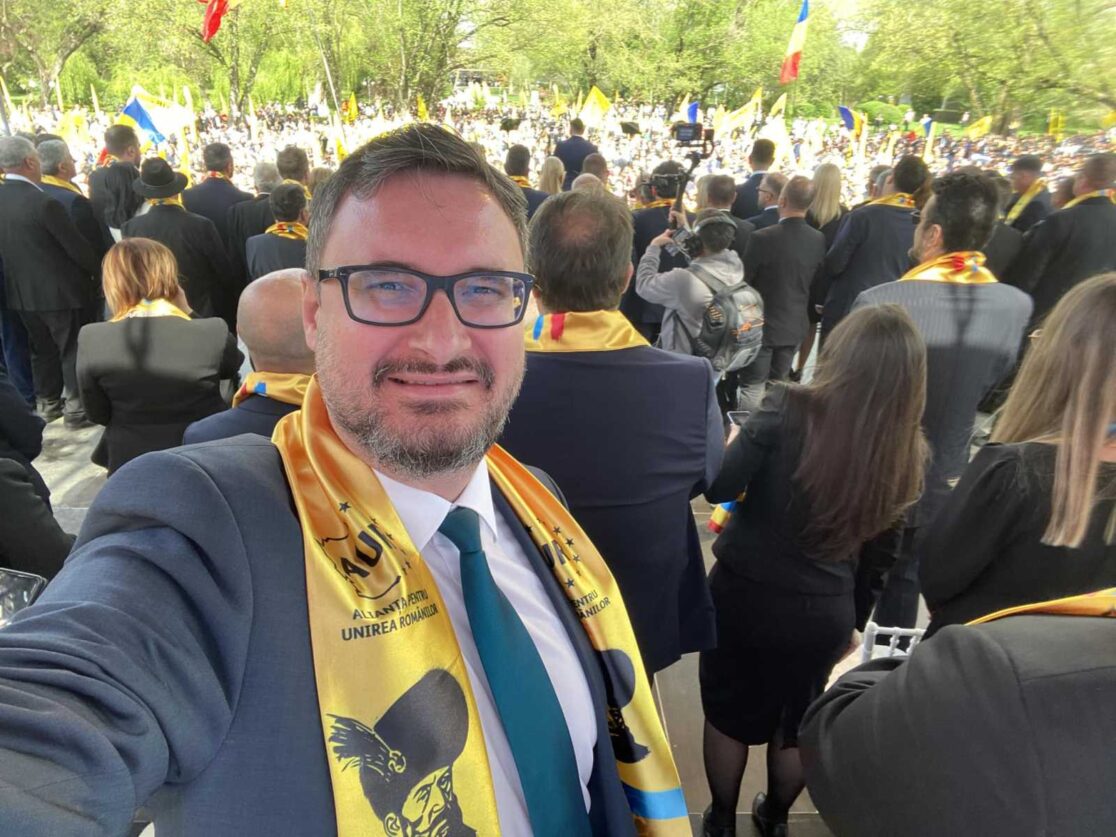
Lucian Mușat, an AUR member of Parliament, delivered a political statement entitled “Transilvania este România” (Transylvania Is Romania), in which he painted an extremely negative picture of the Hungarian community in Transylvania, referring to his visit to Harghita County. The politician claimed that Romanian is not spoken at all in Harghita County, that an interpreter is needed to communicate with local residents, and that displaying the Romanian national flag could result in verbal abuse, physical assault, or even death.
These serious allegations were made without presenting any concrete, verifiable evidence. Based on alleged personal experiences, the politician conveyed a generalized image portraying the entire Hungarian community as a hostile social group opposed to the Romanian state. Such serious statements are capable of generating fear, distrust, and hatred towards the Hungarian population.
The most alarming aspect of the statement, however, is that the MP not only stigmatized the Hungarian community but also advocated measures aimed at restricting its social and political opportunities. His proposals included eliminating the parliamentary presence of the Democratic Alliance of Hungarians in Romania (RMDSZ), administratively reorganizing Hungarian-majority counties and merging them with Romanian-majority counties, and settling Romanian populations in Hungarian-majority regions through nationwide industrialization programmes.
In this regard, we would like to draw attention to the fact that Romania has ratified international conventions which clearly state that the boundaries of administrative units must not be drawn in a way that restricts minority rights. Our Service considers it unacceptable that AUR politicians are advocating the elimination of the RMDSZ, thereby seeking to dismantle the political representation of the Hungarian community. This in itself constitutes an attack on democratic processes.
Equally serious is the statement made by AUR politician Dan Tănasă, in which he accused Hungary and Russia of coordinating actions against Romania and linked the RMDSZ to supporting these activities. The politician made allegations portraying Hungarian political representation as an alleged instrument of foreign powers and as a threat to Romania’s security, despite the fact that these claims have no basis whatsoever. On the contrary, the political representatives of the Hungarian community have consistently and emphatically distanced themselves from Russian aggression on every possible occasion.
According to the Mikó Imre Legal Protection Service, these developments are clear warning signs that anti-Hungarian rhetoric is once again gaining ground in Romanian political discourse. The normalization of such statements has serious consequences: it reinforces prejudices against Hungarians and increases ethnic tensions. Our Service has filed complaints with the National Council for Combating Discrimination (CNCD) in both cases.
Erika Benkő, Head of the Service, stated: “Over the past two months, our Service has been forced to turn to the National Council for Combating Discrimination on five occasions, and to the courts on one occasion, in order to report anti-Hungarian incidents and statements. This is also an indicator of how widespread anti-Hungarian sentiment is in Romania and how it has now become a phenomenon in its own right. On the one hand, AUR has launched a carpet-bombing campaign of anti-Hungarian attacks against our community. On the other hand, this inflammatory rhetoric has had, and continues to have, its intended effect, becoming increasingly visible throughout society. The situation is serious. In other countries, statements such as those made by AUR representatives would result in expulsion from the party, resignation from parliamentary office, and withdrawal from political life. Unfortunately, instead, AUR representatives continue to poison political discourse and relations between communities.”