

Romania’s High Court sentenced two Hungarians from Târgu Secuiesc/Kézdivásárhely to 5 years in jail each on terrorism charges. István BEKE and Zoltán SZŐCS have been accused of attempting to detonate homemade, improvised explosives during the 1st of December 2015 celebrations in their hometown.
Read more…
Absurd jail sentences for two Hungarians on terrorism charges
Trumped-up accusations of theft at an international conference on the use of languages

The overzealous Romanian activist, Dan Tanasă, called the police at an international conference organised by the Covasna County Council and the Council of Europe, stating that his promotional materials and brochures, meant to be handed out, were stolen.
Anti-Hungarian inscriptions on stickers in public spaces
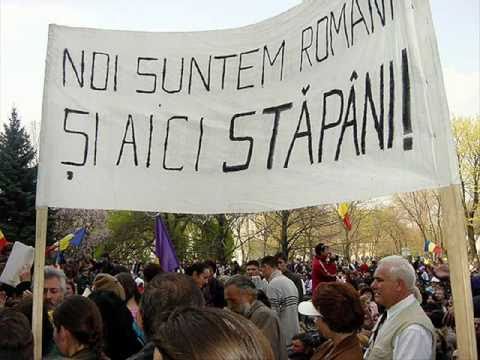
Severe anti-Hungarian inscriptions appeared in recent days on stickers in the municipality of Oradea/Nagyvárad. These inscriptions, with the Romanian national flag in the background, state that ”We are Romanians and we will defend our land, our people and our history”. Under the text, in the yellow centre bar of the national flag, the word ”Hungary” and the Hungarian flag are crossed out. But the most xenophobic aspect of the inscription is the part at the bottom of the sticker, namely a derogatory and deeply insulting term used by Romanians to refer to the Hungarians. This expression is often used with the purpose of inciting hostility towards the Hungarian community.
DAHR informs ECRI about the discrimination against the Hungarian community in Romania
Several members of DAHR reported last week to a special delegation of the European Commission on Racism and Intolerance (ECRI), who were on a fact-finding mission in Romania. DAHR also submitted a written report to ECRI, in which they highlighted some of the most pressing issues concerning the rights of the Hungarian community.
The future of medical training in Hungarian is in danger

Ever since its foundation in 1945, there has been a slow but relentless effort to encumber Hungarian training at the University of Medicine and Pharmacy of Tîrgu Mureș/Marosvásárhely, an institution originally destined to train Hungarian doctors in their mother tongue. However, presently Hungarian students make up just 29% of the total number of students, while Hungarian teachers also constitute a mere one third in the university leadership. In practice, this makes it extremely difficult to safeguard teaching in Hungarian. It is worth mentioning that practical courses are already taught exclusively in Romanian.