
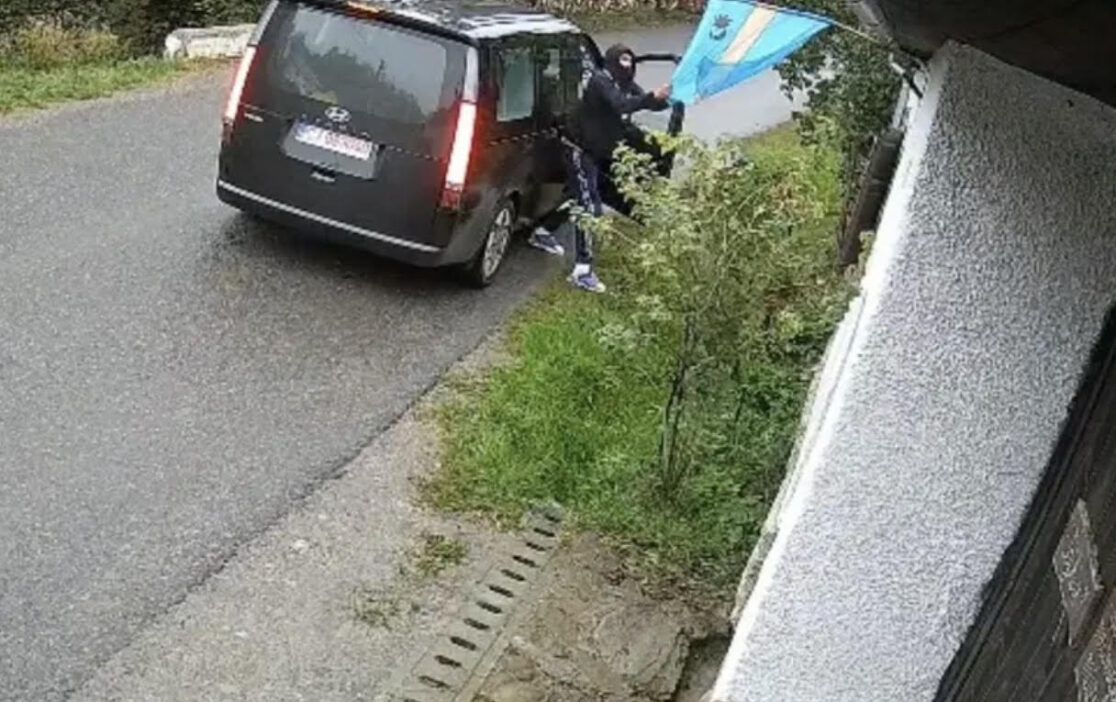
Following Saturday’s football match between FK Csíkszereda and Universitatea Cluj, fans of the Cluj team vandalized Székely flags at several locations on their way home. The incidents took place in the villages of Énlaka, Kőrispatak, and Csekefalva, where, according to community reports, the perpetrators tore down, shredded, or threw to the ground flags that had been placed on private property. Eyewitnesses said the vandals were traveling in a car with Cluj license plates, spoke Romanian, and stopped at several houses to desecrate the displayed Székely symbols.
Such acts — whether the desecration of symbols, vandalism, or hate-motivated aggression — are not merely attacks against private property but violent acts that fuel serious social tension. They threaten peace between communities, undermine the legal security of minorities, and violate human dignity.
For this reason, the Mikó Imre Legal Protection Service has filed a complaint with the competent authorities, requesting a swift and thorough investigation, the identification of the perpetrators, and their prosecution. At the same time, we strongly condemn such actions, which cannot be justified by any political grievance or sports allegiance, and from which every democratic society must distance itself.
The Székely flag, national emblems, and other symbols represent community values that reflect not only our past but also our identity. Communities rightfully regard these symbols as expressions of self-identity, and their destruction constitutes not only material damage but also moral injury. It is the duty of the rule of law to provide a credible response in such cases and to ensure that no one can be intimidated or coerced into hiding or refraining from displaying their symbols.
The Mikó Imre Legal Protection Service firmly stands for the protection of community symbols and consistently opposes all manifestations aimed at intimidating or humiliating the Hungarian community.
Regarding the incident, the head of the Service, Erika Benkő, emphasized: “These incidents occur primarily because Romanian history education still reflects the nationalist-communist mindset of the Ceaușescu era — according to which Hungarians here are mere intruders, and the ‘real’ natives are the descendants of Daco-Romans, who were oppressed for centuries by Hungarian ‘grófs.’ Official Romanian historiography simply serves the process of nation-building — in its very early, myth-making phase. This intense and aggressive anti-Hungarian sentiment will not end until the perspective of history education in this country changes, as it currently treats anti-Hungarian hatred as a legitimate historical reaction and as part of Romanian national identity. This phenomenon can only be addressed if Romanian national consciousness ceases to define itself in opposition to Hungarians, and if the education system ensures that future generations are not raised to hate historical minorities, but rather to recognize their centuries-long presence in the country and regard them as an added cultural value. We saw during last year’s elections how a misinterpreted sense of history can easily veer toward extremism. These are serious issues that must be addressed at a societal level.”