
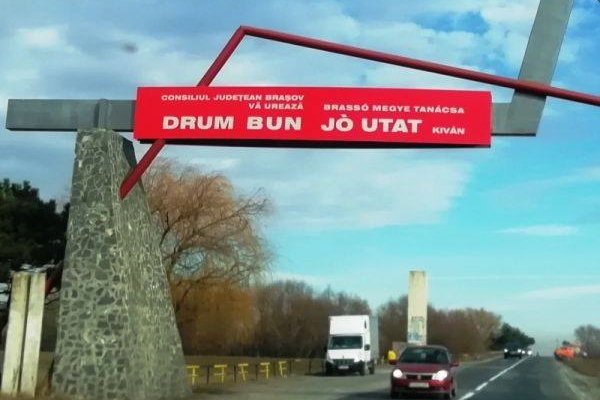
The Civic Association for Dignity in Europe, led by Dan Tanasă, a widely known anti-Hungarian nationalist provocateur, continue their vicious fight against Hungarian signs and inscriptions. Their latest action resulted in a first degree court ruling ordering the removal of a bilingual greeting sign on the border between Covasna/Kovászna county and Brașov/Brassó county.
The sign in question had been put up in 2013 by the Brașov County Council, as a result of successful discussions with the Democratic Alliance of Hungarians in Romania (DAHR). Tanasă’s organisation sued the county council in November 2018, arguing that the Hungarian population in Brașov/Brassó county does not reach the threshold of 20%, and therefore putting up bilingual signs violates the law, according to Tanasă.
However, as our organisation has repeatedly argued in connection with similar cases initiated by Dan Tanasă, and as several leading political figures have also pointed out following this latest incident, the law does not prevent public administrations from putting up bilingual signs when the required threshold of 20% is not reached. As pointed out by Attila Kovács, the president of the Brașov county organisation of DAHR: “The county and the city council took a decision that even though the percentage of Hungarians does not reach 20%, they will nevertheless put up the signs, thus recognising and emphasising the historical bilingualism of Brașov/Brassó county.”
Others have stressed that this incident also points to a double standard when it comes to the linguistic rights of the Hungarian community. As Árpád Antal, the mayor of Sfântu Gheorghe/Sepsiszentgyörgy in neighbouring Covasna/Kovászna county underlined, such an interpretation of the law would mean that the bilingual (Romanian-German) place name signs in Sibiu/Hermannstadt (where the German population also does not reach the 20% threshold) are also illegal, yet they have been up for several years and no-one sued the local council for this.
Representatives in Brașov/Brassó county declared that they will appeal the court decision and will continue to fight for linguistic diversity in their county.
We find it extremely regrettable that the justice system supports such malicious, nationalist endeavours, overriding in this case a peacefully reached decision by Romanian and Hungarian representatives in Brașov/Brassó county, a decision that should instead have been held up as a positive example and a sign of normalcy and respect in interethnic relations.